
What do Archimides and Mafia have in common?
They were born in Sicily, in different eras. My mom voiced her concerns when I told her that we were going to Sicily for vacation. She knew about the place’s association with the notorious organized crime network. Before I set foot on Sicily, what I knew about Sicily was mostly from the movie “The Godfather”. But that was not the reason I decided to go there. I heard that Sicily had an extremely rich cultural heritage and I wanted to explore it.
Our Trip

We embarked on the Sicily trip in March 2023 after a friend made multiple trips there within a span of a few years. Sicily must possess something special if it had made her visit there again and again, we thought.
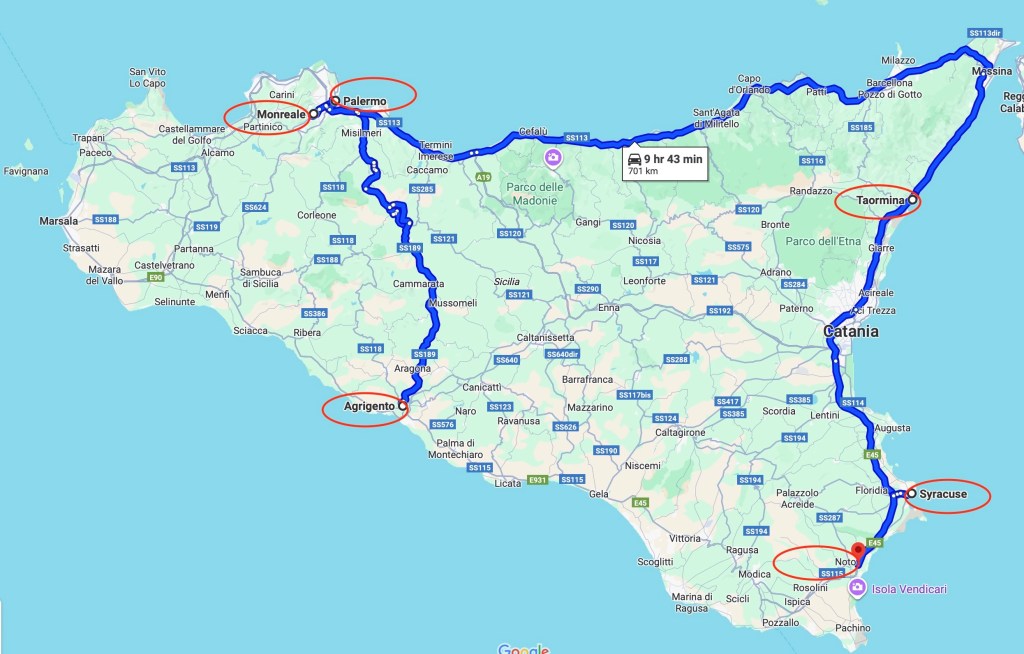
We flew to Palermo, took a train to Taormina, then to Syracuse, then a bus from there to the Catania International Airport to depart from Sicily. The whole trip was about 11 days. We had 3 stops and spent about 3 full days on each stop: Palermo, Taormina, and Syracuse. We took 3 day trips: a day trip to Monreale by bus and a day trip to Agrigento by train from Palermo, and a day trip to Noto by train from Syracuse.
Palemo

Four Conners is the intersection of two major pedestrian streets, and is the center of activities in Palermo. Each corner stands a heavily decorated Baroque building with fountains, statues, balconies. It is lively and crowded. Live music and street artists of all sorts tend to perform here. Open air markets, restaurants, museums, libraries are either on the street or close by. Our vacation rental was nearby. So we come here at twilight almost every evening to eat, to stroll, to feel the vibe, and to see people and the ornate building facades.
There are several open air markets in Palermo. I suggest a visit to at least one market just to feel the abundance of Sicilian food culture and get a taste. I envy the diversity and freshness of their food.
Monreale

Monreale is a small hill top town about a half hour bus ride from Palermo. It is known for the basilica and its cloister, mosaic art, and the roof top terrace. The basilica is in typical Norman style, with two beefy square bell towers at one end. It is best known for two things, the Byzantine style mosaic wall art that depicts Noah’s Arc stories, and the cloister in its attached monastery. The mosaic art rivals any Byzantine mosaic artifacts that I’ve seen. The cloister is influenced by Arab style. The columns are slim compared to Greek and Roman columns. The columns and capitals are either inlaid with glistening geometrically patterned glass or carved with bible stories with vivid figurines such as Adam and Eve. The details in these columns and capitals are shockingly elaborate.
A few blocks from the basilica we sat in the plaza at the front of a restaurant and enjoyed lunch under the lovely Sicilian sun, watching passers-by on the street, colorful clothes on the drying lines between the balconies on colorful buildings, and a well dressed local couple sitting at the next table to us enjoying their lunch and wine. A relaxing atmosphere really needs to be soaked in.
Agrigento

Agrigento is about a couple of hours by train from Palermo. It was known for the Valley of Temples and Turkish Steps. The former is a Greek ruin and the later a natural rock formation by the sea.

The Temple of Concordia is the star of the Valley of Temples. Most of the temples were sacked and struck down by monotheists because they were pagan. Some only had columns left, standing or lying on the ground. The Temple of Concordia was converted to a Christian church and thus survived. It is one of the big Greek temples still standing.

Turkish Steps is a taxi ride away from the Valley of Temples. It’s a cliff jutted out from the shoreline into the sea, but what sets it apart from other cliffs is its sheer white color standing out from the dark colors of the rocks around it. The white cliff also forms a dramatic contrast against the blue Mediterranean water.
Taormina

If you are looking for a resort city in Sicily, look no further than Taormina. It has beaches, trails, aerial trams, manicured gardens, tidy streets, flowery allies, historic ruins, and picturesque public squares. Taormina is a hill side town looking over the Mediterranean Sea. On the south side is Mt. Etna, the biggest volcano in Europe, and still active. The best place to appreciate this dramatic location is at the ancient Greco-Roman amphitheater perched on the highest point of the town. You can gaze at the blue Mediterranean Sea and snow capped Mt. Etna in the same frame. From the back side of the theatre, you can also look over a small island called Isola Bella at the foot of the city like a fairy land.

There are many moderate hiking trails close to the town. We hiked 3 trails, Isola Bella, Madonna della Rocca, and Castelmola (hiked myself). All the hikes are scenic and good workouts.

Syracuse

Syracuse was once the biggest city in the ancient Greek world. There is an Apollo Temple at the town center, now a ruin. There is also an ancient Greek amphitheatre and an ancient Roman arena in the north side of the city. A fortress, now a museum, is guarding the city at the southern tip. The town square in front of the basilica is most impressive. It was converted from a Greek temple. The Doric column colonnade was turned into the church wall but parts of the columns were still exposed. The Baroque facade of the basilica is one of the signature works of that era. The Baroque style Fountain of Diana in front of a downtown square is also representative of the flamboyant Baroque style. Take a stroll there after dark and you’ll be dazzled by the light and water show.

Noto

The small town of Noto is about an hour by train from Syracuse. This quaint town is overloaded with Baroque buildings that blew my mind away. The Noto Cathedral is one of the Baroque masterpieces. The best viewpoint to look at it is from the balcony of the city hall across the street, which itself is another Baroque work of art. We strolled in the quiet streets just a block or two away at the back of the cathedral. The details on some residential balconies made me wonder who once lived in the houses and commissioned the art work so extravagant.

About Food

Sicily is the birthplace of cannoli, squid ink pasta, and eggplant pizza (the first two are also signature food of the North End in Boston, known for its Italian food). Eggplant pizza is the most delicious pizza I’ve ever eaten anywhere. Gelato and freshly pressed juice stands are commonplace. Sicily has an abundance for oranges, pistachios, and almonds. We bought oranges and almonds from the open air farmers market for snacks. They were local and wholesome, and most importantly, delicious. I found their open air markets most interesting, especially fish stands. The variety of fish there was just eye-opening. The chance is that you’d see fish that you’ve never seen before.

About Architecture

What impressed me most was how widespread the elaborately decorated Baroque buildings were in Sicily. Baroque style is famous for its glorious ornamentation, curves, swirls, circles and symmetries. The style just screams “look, I’m fabulous”. Yet I could see buildings in this style virtually everywhere in the cities, as if such extravagance cost nothing. There must be no shortage of wealth and craftsmanship there.
Final Thoughts

The Mafia could have been a product of power vacuums created by land grabbing between the big colonizers, and was a thing of the past (well, if you don’t count modern-day closed circles that assert underhanded influences in many areas like my son’s basketball travel team-one of my fellow parents called it mafia). I saw far more Archimides and his famous Pi souvenirs. We had many walks on quiet back streets after dark in Sicily and we didn’t feel unsafe for a second. Nowadays Sicily is experiencing a renaissance of tourism drawn by its unique flavor of history, culture, and of course, food. We were delighted that we participated in its renaissance celebration and had a taste of its many flavors.

Lessons Learned
When I thought of a train, multiple cars linked one to another with a locomotive somewhere in the chain came to mind. We bought the train tickets from Syracuse to Noto and were waiting for the train on the platform. Trains came and went by the platform. But by the scheduled time for our departure there was no train showing up bounding Noto’s direction. I was in panic. Several platforms away there was a single car parked on a side track like an orphaned on an abandoned track. I ran to the car with desperation. It turned out to be the Noto-bound train that I had been looking for all that time! We jumped on the car seconds before it chugged away, phew!! Stereotype (in this case, my notion of what constituted a train) made a fool of me and almost ruined a good day of vacation.

The following are some thoughts prompted by this visit to Sicily, which could be severely uninitiated and flawed. So skip it if it isn’t of interest to you.
Geo-determinism?

Human civilizations seemed to emerge along river banks-Tigris and Euphrates rivers, Nile River, Indus and Genges rivers, Yellow and Yangzi rivers…, if you believe agriculture is a catalyst of civilization. Civilizations then or concurrently also started around the Mediterranean Sea-Carthage, Assyria, Troy, Greek, and Rome…, if you believe trade is an engine for civilization. Geography played a pivotal role in shaping human history in either case.

Sometimes geography could mean inevitability. Sicily is a prime example. It is the biggest island in the middle of the Mediterranean Sea, off the toe of Italy, midway between two big continents, Europe and Africa. This strategic location sparked off numerous wars and resulted in frequent colonization power rotations. First, Carthaginians from south; then, Greeks and Romans from east; then Arabs from south; then Normans from north; then Spanish from west.

In the 11th century BCE, Carthaginians from North Africa colonized parts of the island. Other parts of Sicily were then colonized by the Greeks in the 8th century BCE. These parts were also called the Magna Graecia (Greater Greece). Then Romans came in the 3rd century BCE and drove out Greeks and Carthaginians. The great mathematician Archimides was killed by the Romans while he was defending his home town Syracuse, one of the biggest Greek cities at that time. Centuries later Arabs from North Africa came and drove out Romans. Normans from the North drove the Arabs out 200 years later. The Spanish then ruled Sicily before it became part of the unified Italy. Sicily is now an autonomous region of Italy.

Many great cultures paraded through Sicily. Carthaginian, Greek, and pagan Roman came to Sicily in turn. Sicily was converted to Christian when Rome established Christianity as its official religion (that Christian era of the Roman Empire was also known as Byzantine). Islamic prevailed when Arabs took over the island around 9th century AD. It went back to Christian world when the Normans drove out the Arabs about 200 years later. Spanish succeeded Norman a few centuries later. At the center of the capital city Palermo, the extraordinarily ornamented Four Corners, there are statues of four Spanish kings, one on each corner.

The rich cultural heritage was clearly demonstrated in Sicily’s architecture. Greek temples scattered the island. The renowned Valley of Temples in Agrigento“ is one of the largest Greek ruins in the world. It was hard not to notice Mosques-coverted churches in Palermo, with the unique onion-shaped Islamic domes and minaret-turned bell towers. Norman style churches are common among the basilicas in Palermo area, with arched portals with broad triangular facades, and symmetrical twin bell towers. Throughout the island, Baroque style buildings and fountains are ubiquitous, showing heavy Spanish and Italian influence.
Why I Blog
I could think of many lofty reasons to blog: to entertain my parents who are no longer able to travel, to share tips and pitfalls to avoid for friends who may plan to travel to the same places as I did, to organize our reservoirs of photos that have been accumulating forever… But my primary impetus for taking travel notes is a rather selfish one, to reflect on what I saw. In a sense, I’m reliving the moments while I’m writing these down. If others happen to find the notes to be useful, then the log has got a second life.
I come, I see, I voice.


Leave a Reply