
The Trip
What’s on your travel bucket list?
Turkey has been on my bucket list for a few years. It’s an end point of the ancient Silk Road, also a major layover stop for travelers flying between China and the U.S..
Can you find Turkey on the globe?
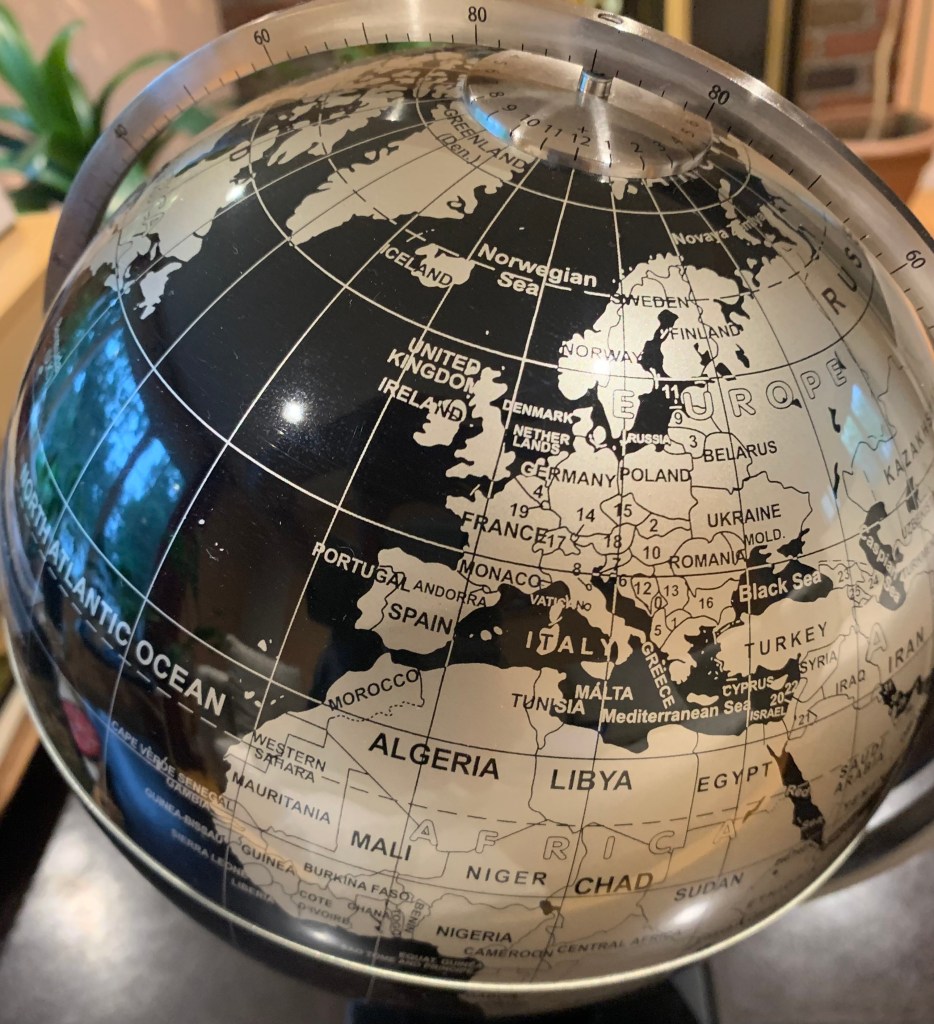
Our Turkey trip was about 9 full days, starting on 6/12 and ending on 6/23. We spent roughly 3 days each at the major stops – the biggest city Istanbul (hotel in Sultanahmet District), heartland of Cappadocia (hotel in Goreme Town), and the Aegean coastal region (2 nights each in Pamukkale Village and Kusadasi waterfront overlooking the marina on the Aegean Sea).
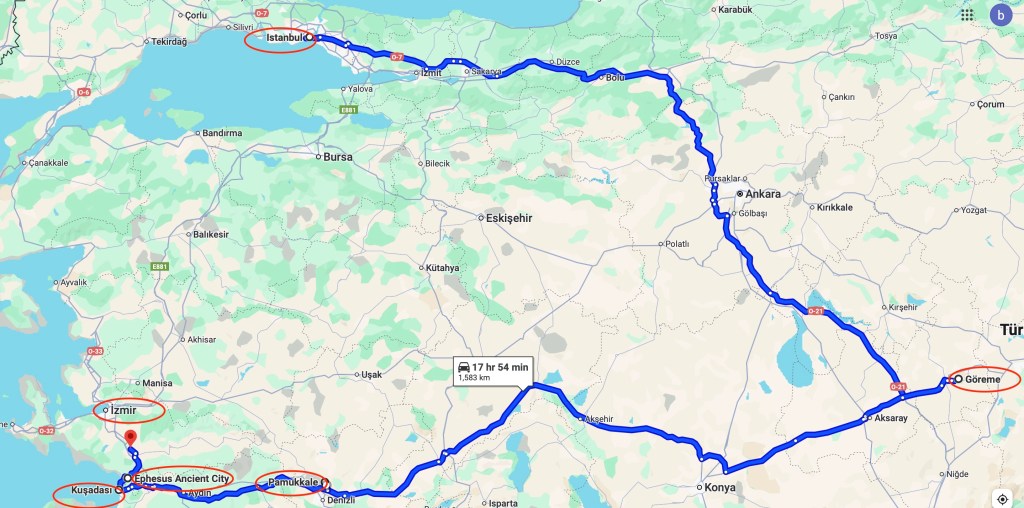
For our international flights, we chose an open-jaw route, eliminating redundant stops to minimize the travel time. We arrived in Istanbul and departed Turkey from Izmir Airport. For the domestic portion of the journey, we traveled by air and land. We flew from Istanbul to Cappadocia, then drove the rest of the way, to Pamukkale, then to Kusadasi, and finally to Izmir Airport. The transportation was smooth and uneventful-every traveler’s dream.
When we plan a trip, we always try to minimize time spent on transportation. At each stop in Turkey, we stayed at hotels right in the activity centers within walking distance to restaurants, entertainment, shopping, and attractions as much as possible. We accomplished the goal on this trip.

Geography, History, and Culture

Turkey is vast, geographically, historically, and culturally. One of the few countries in this world that spans 2 continents, Turkey straddles Asia and Europe. The area where Turkey is located is known as Asia Minor-Little Asia. It is a land jutting from Central Asia into the Black Sea to the North, the Marmara Sea and the Aegean Sea to the west, and the Mediterranean Sea to the south. The land covers an area about France and the UK combined. The trip from central Turkey Cappadocia to the western part of the country Pamukkale took us about 8 hours with 3 of us taking turns driving in excellent traffic and road conditions.
Its history is almost as old as human civilization. The oldest bread was found in Turkey, dated to some 12,000 years ago – so says Turkish Airlines, which serves bread inspired by it for an in-flight dinner. It’s the birthplace of yogurt – so claims a giftshop owner. I checked it online and he’s right. Many of their condiments are yogurt based. Most people link tulips to the Netherlands, but they may not know that tulips-Turkey’s national flower-spread to Europe from here.
Turkish culture goes with its geographic location – a fusion of western and eastern traditions. Since Persia (under Cyrus II) invaded the area in 500s BC, Turkey has been through a parade of political, religious, and cultural systems – Persian, Greek (Alexander era), Roman (the pagan era), Byzantine (Christian empire), Mongol, Ottoman (Islamic empire), and modern secular constitutional republic founded by Ataturk – meaning “father of Turks” in Turkish. This land has inspired some well-known myths like Helen of Troy and the Trojan Horse.
Today’s Turkey, although the political system is a constitutional democratic country, is a muslim society with mosques everywhere and calls for prayers filling the air every so often. The pristine highway system extends to everywhere we went, which is a large portion of the country. We didn’t hit a pot hole during our road trip. Except for the vastness of the land area covered, our road trip in Turkey was a breeze (we didn’t drive in Istanbul – traffic is bad there). It’s a modernized country with an unmistaken Islamic culture.
Landscape

Turkey’s landscape is diverse. I was told that Istanbul has the most skyscrapers among European cities, yet I saw ancient sites scattered everywhere in the city – an Egyptian obelisk, a Roman aqueduct, a Byzantine underground cistern, Byzantine churches, and Ottoman style mosques and imperial palaces. Beautiful up-scale villas decorate lush green hills along Bosphorus Strait. Busy bazaars, restaurants, and marinas line the Golden Horn waterfront.

Mother nature’s work in Turkey is nothing short of wonderful. In Cappadocia, land covered with volcanic ash forms some of the most dramatic landscape man has ever seen. The volcanic ash turned into fairy tale mushroom shaped rocks after millions of years of erosion. Locals built shelters, storage, and churches in those rocks.

Dissolved calcium in the hot spring water solidified and deposited wherever the water flowed through and the deposits formed cotton-white travertine cascades in Pamukkale (cotton castle in Turkish). The travertine covers a mountain slope the size of many football fields that you can see from miles away.

This vast land area offers many varieties and contrasts. We saw quaint villages where sprawling wheat fields roll and grazing sheep roam. We also saw bustling cities where fancy yachts moor and luxury cruises come and go. Who doesn’t like this kind of dynamic?
People

It doesn’t hurt that almost everybody we encountered spoke some English (though most of the signs are in Turkish). That makes communication with the locals relatively easy. Also, I don’t recall that I’ve met a rude person there – yes, some street vendors can be pushy but I’ve seen more dramatic vendors in some other countries. A parking lot attendant recognized us when our car returned later that day. He waived our parking fee for the recurrence. A similar situation happened when we had difficulty getting Turkish lira from an ATM. The attendant let us park for free. Nice people.
This is the land that produced Helen of Troy, according to Greek mythology. Some of the local females’ faces resemble those of the classic Greek statues – small faces, large eyes, chiseled noses, and well-proportioned facial features. It could be that they are descendants of whom those statues were modeled from.
Istanbul

Aya Sofya is a must when you visit Istanbul. This modern-day mosque symbolizes the glories of two great empires, Byzantine (Eastern Roman) and Ottoman. It had been the biggest church in the whole Roman Empire and Christian world for centuries before the fall of Constantinople to the Ottomans under Sultan Ahmed in 1453 AD. The city name has been changed to Istanbul and the church has been converted to a mosque since then. The remnants of the famous Byzantine mosaic art work depicting Bible stories are still on the interior walls and dome ceilings of the building. The mosaic pieces on the dome ceiling in the line of sight of prayers from the praying floor are thinly veiled. The ground floor is not accessible by visitors. It is only open to muslim prayers.
There are too many other things to see and do in this big city.

Want to see ancient jewels and artifacts? Go to the Topkapi Palace, the imperial palace of the Ottoman Empire. You’ll see the biggest diamond in the world and the sword David used to fight with Goliath (so said the label) there. David is a prophet in Islam. You also get the best view of the Marmara Sea there.

Want to see tinted glass and experience the prayer floor of a mosque up-close-and-personal? Go to the Blue Mosque. Carrying your shoes around may save you some time going back to the shoe rack to retrieve your shoes when you exit the Mosque. I still didn’t get why it’s called the Blue Mosque while I saw more red than blue there.

Want to do some window shopping and people watching? Go to the Grand Bazaar and/or the Spice Bazaar. Grand Bazaar is said to be the world’s biggest bazaar. Spice Bazaar was an eye candy for me to see all sorts of exotic spices and their vibrant colors.

Want to get a panoramic view of the city? Go to the top of the Galata Tower. You will see boundless land and water from there: Marmara Sea, Golden Horn, and Bosphorus Strait dividing the city into Europe and Asian sides, and Europe side into Saltanahmed and Galata districts.

Want to cruise the Bosphorus Strait? Take a sunset cruise. There are an array of classes and types for the cruises, but they have one thing in common – the Bosphorus cruises do not go all the way to Black Sea. Nevertheless, it’s worth chilling out on a cruise after a day of city walking, soaking in what the land and water have to offer at the confluence of two continents and two seas.
Want relaxation after a day of sightseeing? Go to experience the famed hammam – Turkish bath. It may include a dry hot room, steam room, body rub, skin scrub, bubble bath, foot massage… In the intermission of the hammam, perhaps after a body rub, you may be sitting with a stranger or two across a coffee table, sipping Turkish tea, scantily dressed in a bath towel and bath shorts. But no worries, just relax.
Cappadocia
“Land of Beautiful Horses”. That is what the word “Cappadocia” means in Turkish. We do see a few horses there grazing grass once. However, I’d exchange “horses” with “balloons” because nowadays the region is known for one thing – hot air balloon rides at sunrise.

When we booked our hot air balloon tickets, most rides were already sold out. Unable to book the ride for the first morning we would be there, we booked a ride for the second morning, figuring we’d have the next morning as the backup. This decision proved to be crucial.
The first day in Cappadocia was a series of road trips to see the renowned natural landscape and man-made caves in it.

Underground City – layers upon layers of caves dug out of hardened lava ashes – were used as temporary shelters by the early Christians in the eara to hide from pagan persecutors. That was a time when you could get killed for being a Christian. There were also times when you could get killed for NOT being a Christian. Humans are strange beings.

There is an above ground version of the Underground City – Uchisar Castle. It is spacious and airy, carved in a colossal rock maybe 10 stories tall on the highest hill top in the area. It is a great spot to get a panoramic view of the Cappadocia landscape. There is a miniature stationary balloon at the foot of the castle. In case you can’t ride a balloon you can fake a balloon ride picture with yourself in the balloon and Uchisar Castle in the background.

There’s no better place to see the signature “fairy tale mushroom” rock formation than Devarant Valley, Pasabag, and Love Valley (which we only viewed from the balloon). Devarant Valley is a roadside attraction where you can hike the rock formations in the wilderness endlessly. There is no trail marking, no boundary, and no signs. You know you reached Devarant Valley when you see devilish rocks and chaotically parked cars on the roadside.

Pasabag is a gated park with trails. The rocks here have the best mushroom resemblance and most photo-worthiness, with black cone-shaped caps and white cylindrical stems, indeed a fairy tale land.

The next morning the alarm woke us up at the wee hour of 3. A van picked us up at 3:30. The staging area is a nice cafeteria with a breakfast buffet. We were bused to the balloon takeoff ground, waited and waited. Then the announcement came: all missions aborted. I can’t remember how long ago since I saw the sunrise, but I saw the sunrise on my trip back to the hotel that day- I was not an early morning person.
After we got back to the hotel, we called the balloon tour operator to see if there were openings for the next day’s ride. A few hours later we got the OK . We were lucky!
Some are not so lucky. A nice young couple who came from half a world away from South Africa had a flight to Istanbul to catch in the afternoon. Pretty sad to see their disappointment. It was the last day of their Cappadocia stay for an older Japanese couple who are world travelers. They had taken a balloon ride previously on an African savanah.
A Spanish teacher from Seattle was on his 18th(?) week of vacation traveling much of the world with his wife. He was going solo to the balloon ride because his wife feared height. My wife is acrophobic too. However, she decided that day was the day for her to overcome the fear (spoiler alert – she did it the next day with great composure)!

We had 2 back-to-back rude awakenings at 3 AM. The second time we actually flew! Standing in the balloon basket felt like being on a slow-moving UFO hovering the earth at a low altitude. There was no mechanical noise, no exhaust, just an occasional puff of fire or two into the balloon, at which moment all riders’ faces shimmered with a golden glow and you felt the warmth from the fire a few feets from above – a surreal feeling. The sun rose from the horizon after we soared to the optimal altitude. The sky became a symphony of light – the sun light and fire puffs from a hundred (115 as the pilot said?) hovering balloons in the sky.
After an hour of drifting with the wind, our balloon landed squarely on the landing pad – a trailer the size of the footprint of the 16-person balloon basket, about the size of a couple of ping-pong tables – hats off to the pilot. A hot air balloon has no power at all, just hot air to control the ascending and descending of the balloon. Lighting the fire, the balloon rises. When hot air cools down, the balloon sinks. Opening the little parachute at the top, the balloon collapses. All these controls are done with levers and ropes. The pilot and passengers are at the mercy of the wind to take them wherever the wind blows to. At the end of the ride, a requisite champagne celebration ensued to cheer for this truly special experience.

During the flight, the pilot asked if everybody was excited. Of course everyone was, because it was our first time to do this. The pilot said he was excited too because it was his first time. The air froze. Then he said it was his first time flying in this combination of conditions: temperature, wind speed, wind direction, air pressure, visibility… True – one cannot step into the same river twice. Seize the moment.
Pamukkale

What does Turkey invoke in people’s minds? I grew up in a time pre-hot air balloon tourism and the image I associated with Turkey was Cotton Castle – Pamukkale in Turkish. It is one of the most photographed objects in Turkey – white travertine terraces interleave, hot spring water flows over the terraces forming shallow turquoise pools. The ancient Romans loved to bathe and believed the hot spring had healing properties. They built the city Hierapolis next to the travertine pools. Legend has it that Cleopatra bathed there. She was the Queen of Egypt, wife of Caesar, after his assasination, wife of Mark Anothony (Consul of Rome). Cleopetra’s Pool is one of the biggest attractions here.
Before I went there, I had this fantasy of soaking in the pool, under the shades of palm trees, above the ancient Roman marble columns now collapsed under the hot spring water, pondering the rise and fall of two grand empires and three great rulers.

The hotel manager told me that Cleopetra’s Pool was closed indefinitely for reasons unknown. What he didn’t tell – and I didn’t ask – is that the travertine pools are 99% dry. I was able to take some pictures of the remaining few puddles. But you would feel cheated if you go there based on the pictures. There are a few man-made ankle-deep wading pools on the travertine slopes for tourists to dip their toes in, but one has to navigate through the crowd to get to the few square feet of water that belongs to you. We’ve ruined the ruin.
Ephesus

Among the Greco-Roman ruins that I’ve been to, Ephesus is one of the grandest and most well preserved. It was one of the biggest port cities in the Roman Empire before the port dried up. There is no trace of water today.
The center of the ruin is the Library of Celsus. Its 2-story facade is still standing proudly. The greatness of Ephesus and Rome at its prime is palpable from this facade. Proportions between the doors and columns just feel perfect. Variations between the pediments and capitals just look right. The relationships and dynamics between the different components (doors, columns, pediments, and statues) are strokes of genius.
Ephesus concluded our Turkey journey. I felt that I had a good glance at this vast country (in both space and time).
Lessons learned

I could have done my homework. We solicited the hotel’s suggestion to fill the void left by our aborted balloon trip that morning. When the hotel owner showed us his video clips of Tuz Golu – meaning “salt lake” in Turkish, I got carried away immediately. The place looked like a wonderland – ankle-deep crystal clear water, reflecting like a mirror, flat like a glass pane, endless like an ocean, and just otherworldly with a mysterious pink-ish hue. Why wait? We embarked on our journey to Tuz Golu.
Two-and-half hours of driving later, we saw a bright white-pink-ish strip on the horizon like a mirage – the salt lake! But that was the highest point of the day. When we got there, we found not a drop of water. The lake is enormous. We walked 300 feet into the lake bed. It was bone dry, nothing but salt. The next 10 miles, 20 miles, would be the exact same. I pulled out my phone and started to search for Tuz Golu. The lake has been dry for a few years, the internet says.
Skipping homework is never a good idea – I learned after a dear tuition paid and one vacation day wasted.
Why I travel

An old Chinese saying goes “travel thousands of miles; read thousands of books”. Travel writer and TV host Rick Steves says, and I paraphrase, we travel to gain perspectives of the world. I agree with both – means (travel) to an end (world perspective).
For me, gaining perspective of the world comes as a side effect from my travels. I travel because I want to transport myself to a different world that I fancy. That could be a learning experience, an exotic place, an ancient ruin, a natural phenomenon, a trek, or another planet-like. I treasure every experience interacting with a person out of my usual circle-a hotel staff (who shared his family video with us), a souvenir shop owner (with whom we had a conversation about tulip patterns on the ceramics, origin of yogurt, and the meaning of ubiquitous evil eyes; he ended up giving us an evil eye charm as a gift), a restaurant server (who shared his son’s wedding photo and the couple’s whereabout, and gave us a small parting gift), or a hammam attendant (who told us where she was from). I feel mentally renewed and spiritually enriched after traveling.
Travel can be physically and mentally demanding. You exchange “good” pressure (if there is such a thing) of doing something you really want to do, with “bad” pressure of mundane daily life. Researching, planning, booking, documenting, communicating, coordinating for travel are just some things that take energy and time. But you know you’re working towards a specific, concrete goal you set for yourself.
During a trip, you and your travel companions are one unit aiming at the same goal – to check off the activities you come up with together, documented in your itinerary. For days, you are forced to sleep, eat, walk, and ride together, facing unknowns and solving problems thrown at you by the circumstances. Traveling exposes one’s personality like nothing else – weaknesses more so than strengths. If you love someone, take her or him to travel. If you still like the person at the end of the trip, you are lucky.
When I reflect on the life I’ve lived, I think of my loved ones and those sparkling moments – the travels I’ve done – often with loved ones. If I’m not traveling, I’m planning for a trip – that is my motto.
Travel is good for your body and soul, and is good for mankind. Many problems and biases are rooted from lack of understanding of this world we all live in. I hope more and more people travel, reach out to those people and things that are different from ours, which could help calibrate our own.
What’s your next travel destination?
Bon voyage!


 A Passer-by 过客
Leave a reply to GeoBlogger Cancel reply